
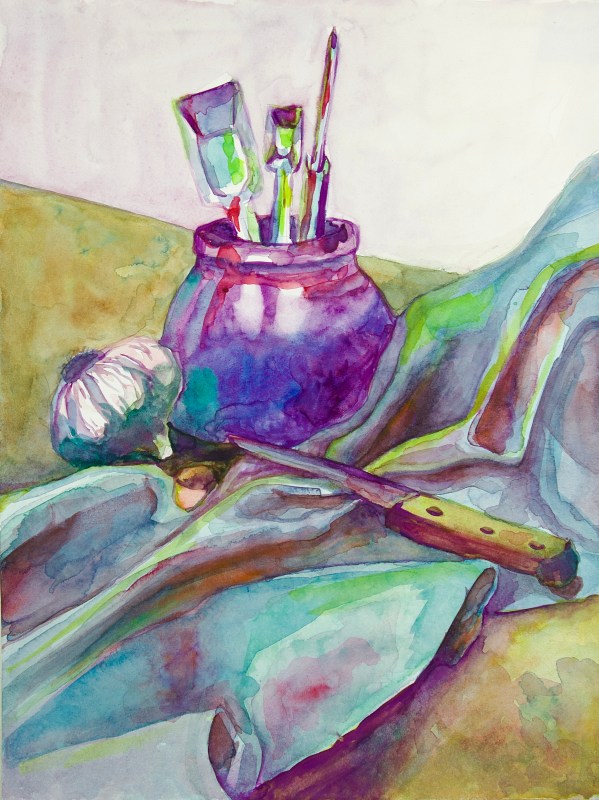
I’ve recently been on a shopping quest to find the starter sets of watercolors and gouache that have the most useful assortment of pigments. In set after set, I’d find one tube that was basically worthless: Violet. I say this because the pigments used in the Violet paint were not light-fast. In many cases, they weren’t pigments at all, but fluorescent dyes (you can read about the problems with those in my fluorescent paint post). Why are paint companies including these in otherwise lightfast paint sets? And (say this ten times fast) where does one find permanent purple pigments? I haven’t exactly found an answer to the former question, but I did stumble into a weird and thought-provoking area of art history. Read on!
First off, let’s get our terminology straight. Violet is one of the least clearly defined color terms, and means different things to different people. However, one standardized definition (which we’ll use here) is that Violet is any color between blue and red on the color wheel which appears to lean towards blue.
Now, let’s answer that second, tongue-twister question. Though lists of available pigments are notably shorter in the Violet section, permanent purple pigments do exist. Most prominently, they are Cobalt Violet (PV14), Ultramarine Violet (PV15), and Manganese Violet (PV16). Dioxazine Violet (PV23 and PV37), a newer, synthetic organic pigment, is also fairly light-fast, though not so absolutely permanent as the first three options. The PV37 version is supposed to be more light fast, but testers have had mixed results with both types. Test your paint before use! Finally, mixtures of Ultramarine Blue and Quinacridone Rose (PV19) make vibrant and light-fast Violets.
Meanwhile, on Artistpigments.org I found many companies using fugitive (non-lightfast) dyes or a mixture of dye with Dioxazine Violet. Often these dyes were Rhodamine, which is toxic; but some sets used Gentian Violet, a coal-tar distillate dye I’m familiar with because it is also used as an aerosol veterinary antiseptic (the product name is Blu-Kote – it’s great for treating uncooperative patients as you can just spray it at them. Also it stains them a lovely purple-blue shade, and who doesn’t love purple pigs!) Besides being fugitive, it’s also carcinogenic – Wikipedia says it can be made from formaldehyde – which I suppose is why it’s only readily available to treat livestock. Shinhan PWC, White Nights, and Rosa all offer Gentian Violet based paints; while Holbein and Mijello Mission Gold have shades of Violet made with fluorescent dyes. In gouache territory dye is even more widespread- Turner, Windsor & Newton, Shinhan, and Holbein are all using fluorescent dye-based Violets.
The desire to use Violet paint at all appears to be a relatively recent phenomenon. One study (also here) examined 139,892 artworks from the Paleolithic to the mid 1900’s and found that before the 1860’s less than 4% of them used the color Violet. After 1860, however, the use of Violet exploded to 37% of art, rising to 48% in the 1900’s – a statistic which is pretty incredible! This well-documented sudden use of Violet was due to the Impressionists, who were painting with the newly invented Cobalt, Manganese, and Ultramarine pigments. Their use of the color did not go unnoticed, with critics accusing them of “violetomania,” or even having vision disorders.
So why were there so few paintings before the mid 1800’s with Violet in them? One theory is that there were more, but the colors have faded. Since high-chroma Violet pigments were totally lacking, and the only cool reds available for mixing the color were Red Lake pigments made from insects and plants (all notoriously fugitive) some Violets would have faded to blue. This video shows how museums go about researching this – it’s worth a watch!
Another theory is that the Impressionists were influenced by new technologies – the desire to try newly available pigments and the huge popularity of just-invented Mauve dye for clothing and textiles. They were also influenced by their environment – the quality of the light is different painting outdoors, where the blue of the sky tilts colors towards the Blue/Violet end of the spectrum. The high degree of air pollution during this period may also have pushed Impressionists to make paintings lighter in value, allowing for more colors (like Violet) in shadows.
The authors of the study have an even more fantastic theory, however, positing that the increase in Violet in art may be due to humans, overall, being able to see the color for the first time. Though human vision as we know it was fully evolved by 30 million years ago, they point out that genetic mutations happen all the time, and perhaps enough of us have gained the ability to see Violet to make it part of our culture only in the last few hundred years.
To be truthful, I find this explanation fairly far-fetched – but it IS fun to think about the idea that our vision, as a species, is always slightly changing. It’s also a good reminder that we all perceive colors slightly differently – or very differently, as is the case for folks with color blindness and those who are tetrachromats (people with four types of cone cells in their eyes instead of the usual three).
Now, art history rabbit-hole aside, why do paint companies today continue to make impermanent Violets? Cobalt Violet used to be made with arsenic and was very toxic. A 1950’s art materials manual I have still cautions its use. These days it’s made a different (non-toxic) way, however it’s not produced in large quantities and the internet is full of rumors that both Cobalt Violet and Ultramarine Violet are no longer being produced at all. At the very least, they’re expensive! Manganese Violet has low tinting strength and is also expensive. If they’re just looking for cheaper/more readily available alternatives though, that doesn’t explain why they don’t use a PV19/Ultramarine mixture or Dioxazine Violet.
A more likely explanation, I think, is that just like the Impressionists, we are drawn to buy new colors that are brighter than any we’ve previously been able to find. Today, we’re also surrounded by super-saturated images created by our iphone cameras. This back-lit quality isn’t easily replicated on paper, upping the appeal of bright dyes. And what better color for a brave new frontier of fugitive brilliancy than Violet?
 Carrie Glessner