How do you go about choosing a brush to buy or use? Although cheap paper or paint will make painting more difficult, an appropriate cheap brush won’t hold you back and may be just the thing for accomplishing your goals. Price is not a stand-alone gauge for what brush to buy. Here’s where a little knowledge of options goes a long way.
As I began compiling a list of brush options for my students, I realized the choices could be arranged similarly to a taxonomic key for identifying plants or animals. So here you have it: brush taxonomy 101: Shape, Hair, Size
As a starting point, you might want to check out this short video showing how brushes are made.
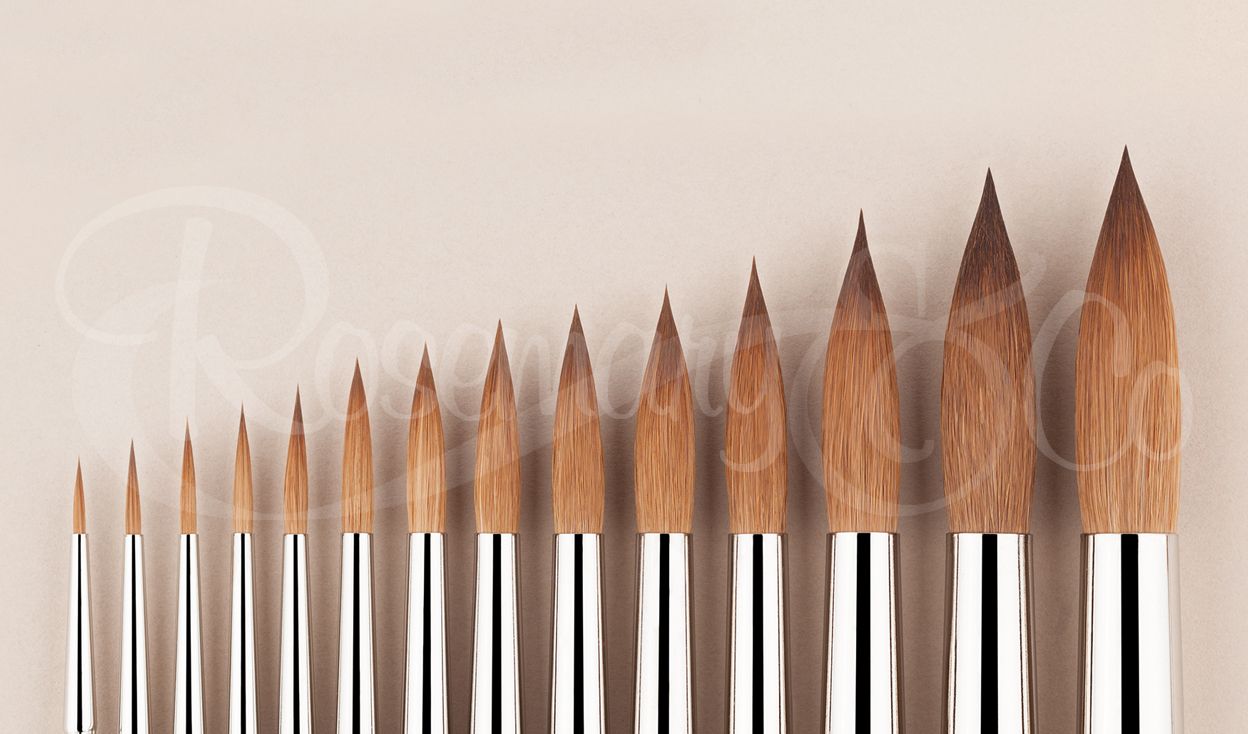
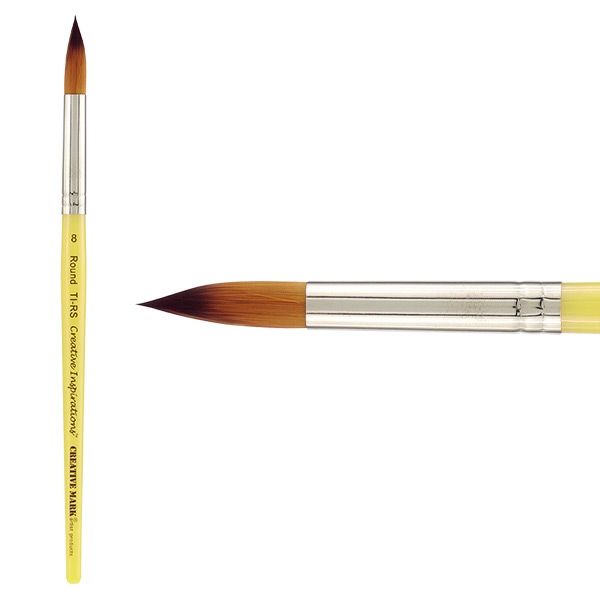
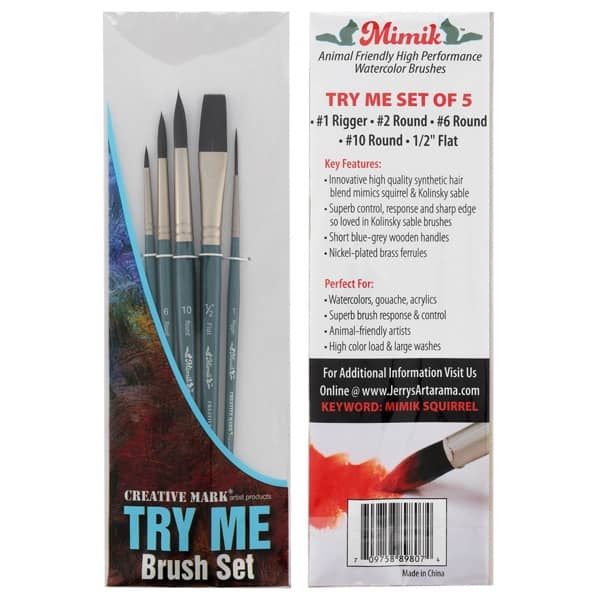
As a case in point, the brush that I use the most is a Kolinsky Sable #8 round from Rosemary and Co. ($69), but I use a Creative Mark Durahandle nylon #8 round (around $3) and my set of Mimik Squirrel brushes (set of five for $13) almost as much. Links on photos if you want to check ’em out.
Brush Baseline: these are the absolute essentials for any watercolor brush (unless you’re using it for some kind of special effect or abstract art)
- Pointy – if the brush is a round, it should come to a fine, sharp point when wet (dry brushes may be bushy or fuzzy) and stay that way while you paint. If it’s a flat, the hairs should end in a crisp line without noticeable individual hairs sticking out longer than the rest.
- Ferrule straight and tight – the ferrule (metal thing holding the hairs together) should be attached in line with the handle, not crookedly. It should fit tightly with no wiggling.
- Not shedding – when you pull (very gently) on the hairs, none should come out.
Brush Shape: Round or Flat
Round
Round brushes have a belly (the wide point of the brush) and a point (the tip). The shape of this profile varies from one brand to another. Brushes with long points make very expressive lines, but are more difficult to control for precise painting. Large-bellied brushes and brushes with longer hairs hold more fluid, which is important for the brushes you’ll use for big washes, but won’t matter for painting details and small areas. A few specific shapes and styles of rounds have special names and uses:
- Rigger (may also be called a Script or Liner brush) – long and narrow, good for long, fine lines (like rigging on a ship!) Most commonly only smaller sizes (1, 2, 3) are used.
- Spotter – short hairs, good for painting little details where you need lots of control. Most commonly smaller sizes are used.
- Quill – instead of having a metal ferrule, quill brushes have a small piece of flexible plastic wrapped around the brush fibers and held in place with twisted wires. Before there was plastic, a hollow quill feather was used, which is how they get their name. Most often, artists use larger quill brushes made with very fine/soft hair such as squirrel or synthetic squirrel as a brush for large washes that also comes to a fine point for detail work. The sizing for quills is totally different than for other rounds, so be sure to check the actual measurements before buying. Some quills have sharp ends on the twisted wires which can catch on things – if that sounds like something that might bother you, be sure to check reviews on this point before buying, or perhaps avoid quills.
Flat
The square shape of flat brushes is favored by many painters because it forces you to simplify and abstract. Fine lines can be created by using the brush on edge. Dry brushed grasses and other textures are another great use. Because the brush doesn’t end in a single, sharp point, I find that inexpensive flat brushes are more likely to be satisfactory than inexpensive rounds; and often wear better. Here are types of flats:
- Wash/Bright/Flat all refer to the same square brush shape. Wash brushes are usually larger, while brights may have shorter hairs and are often intended for acrylics or oils.
- Cat’s Tongue is a flat that tapers to a point. This can be a good alternative to a large round for making big washes, and will cost less and be easier to clean because there’s less fiber.
- Filbert A flat with the corners squared off. This is another brush more commonly found in an oil painter’s kit. In watercolor, the results are very similar to a bright/flat but will give you less ability to make sharp corners.
- Oval Wash is usually a big, soft, fluffy brush for making big washes where you don’t need to have a lot of control over where the paint goes. A cat’s tongue or quill is a more versatile choice for the same application.
- Dagger brushes have a long, pointed end for making expressive squiggles. I think you either love ‘em or hate ‘em.
- Fan and Comber brushes are used for special effects, like fields of grass. A similar effect can be achieved by splaying the fibers of an old round brush with your fingers.
Hair: Natural or Synthetic
Reasons to Choose Natural Hair:
- It’s absorbancy is unsurpassed. Each hair is covered in little scales that fluff up and trap water. It’s a design that synthetics can’t replicate.
- Each hair naturally tapers to a point, which helps the brush keep its shape.
- It’s durable. Be nice to your sable brush and you can pass it down to your children. I personally use a Windsor and Newton Series 7 brush that is likely over 50 years old, and was used throughout its life. The hairs at the tip of synthetic brushes will become fuzzy after a lot of use, so the brush will no longer come to a sharp point.
- It’s satisfying to use a brush that’s the historic gold-standard of brushes.
Reasons to Choose Synthetic Hair:
- Cheaper – and yet it’s possible to make the same quality work with a good synthetic
- Easier to clean (those little scales are hard to wash out)
- Easier to care for. Clothes moths will eat hair brushes the same way they’ll eat wool, and hair can also mold and rot if you put your brushes away wet. Neither of these are concerns with synthetics.
- If you’re not planning to be nice to your brush (such as by painting with gouache or acrylics or painting on an abrasive watercolor panel), buying a natural hair brush would be a waste of money, since any brush will wear out fairly quickly in those circumstances.
- Stiffer and snappier – a good choice for fine detail work or other painting where a stiffer brush will aid precision, or painting small areas where being able to hold a large volume of fluid is not important or will just waste paint.
- No animals are harmed to make a synthetic brush.
Types of Natural Hairs
Sable
Sable brushes are the gold standard for watercolor painting. The hairs have an excellent combination of being highly absorbent and slightly springy, (or snappy) – meaning that the hairs spring back so the brush keeps its pointed shape. The best grade of sable, Kolinsky Sable or just Kolinsky, is the tail hairs of the male Siberian Weasel. Most brush manufacturers no longer sell Kolinsky brushes in the USA due to CITES (Convention on International Trade in Endangered Species) laws. Although the Siberian Weasel is not endangered, its fur is tracked to help stop trade in endangered Mongoose fur which has been labeled as Kolinsky in order to avoid regulation. Weasel hunters in Russia and China, and therefore brush makers, are unable or unwilling to complete the paperwork required to document the source of their product to meet US standards. You can read more about the dramatic, red-tape-filled situation here. The more generic term “Sable” can refer to the hair of any species of red or brown weasel, which are hunted or trapped for the fur trade. The tail hairs are largely a by-product and hairs of several species may be mixed together before being re-sold to brush makers. Sable brushes ARE available in the US, as they weren’t caught up in the Mongoose mis-labeling issue. Many people don’t notice the difference between a Sable brush and a Kolinsky brush, but it all depends on the blend of sable hairs used – a good reason to buy from a reputable art supply store like Dick Blick, Jerry’s Artarama, or my favorite brush source, Rosemary and Co.
Squirrel
Squirrel hair comes to a fine point and is more absorbent than Sable, but it has almost no snap. This makes it a good choice for big wash brushes where carrying capacity is the most important factor, and for expressive mark-making. Squirrel hair comes from several different species of Russian squirrels, and sometimes Canadian squirrels as well. Like Sable, they are hunted for the fur trade.
*Side note: The myth of cheap Sable brushes: Sable and squirrel hair is generally expensive to obtain, so when you see sets on Amazon with three or more brushes for under $20, it’s safe to assume the hair is very low quality sable and/or a mixture of hair from other kinds of animals such as ox or pony hair. If they say they’re Kolinsky Sable, that’s a flat-out lie (or there’s a “kolinsky-like” buried somewhere in the description.) They might still be decent brushes and worth a shot to try, but don’t expect them to be the same as fully sable or squirrel brushes. Most importantly, you won’t know quite what you’re getting until it arrives. As an alternative, reputable art supply stores sell excellent synthetic/sable blend brushes which are less expensive – and have their contents fully described.
Hairs to (generally) Avoid: None of these fibers are generally used by watercolor artists, though you might find uses for them to create special effects in your art.
- Hog Bristle – these are very stiff brushes with coarse hair. They’re designed to carry thick oil and acrylic paint rather than absorb liquid media.
- Ox – from the long hairs inside the ears of cattle. Has good spring but doesn’t taper to a point like sable. Sometimes blended with sable to make less expensive brushes.
- Pony – fragile, soft hairs shaved from the belly of ponies. Pony brushes have no snap and the hairs break and fray easily.
- Camel – a catch-all term for any blend of natural hair, which might include goat, ox, pony, etc. These are often included with cheap watercolor sets. Camel brushes tend to have no snap, no point, and shed a lot, making them frustrating to use.
- Goat – doesn’t make a good point. Often used in Hake brushes and other brushes used for applying glaze, gesso, or other imprecise painting.
Types of Synthetics
Synthetic hair for brushes is made from nylon or polyester, sold under a variety of names such as Taklon (which is polyester specially baked and dyed to increase absorbancy,) white nylon, and golden nylon. Some synthetics are specially formed or etched with solvents to create fibers that taper, have a slight crimp, or a textured surface more like natural hair. High-quality synthetic brushes use these fibers in a blend of diameters in order to mimic all the best properties of real hair (check out this page on Oasis brushes to see how they created a “better than sable” brush) The description of the brush should indicate if they were trying to mimic snappier Sable or softer Squirrel so you can decide what brush you want. Cheaper synthetics tend to be uniformly stiff and less absorbent; and because the hairs don’t taper, they won’t come to as fine a point. Look for brushes made with the same craftsmanship as those made from natural hair.
* A small rant on a brush to avoid: We’ve all seen those little, stubby, non-absorbent brushes with black plastic bristles and no point which are simply the worst possible painting tool out there. Yet they are the brush handed out to children for their first exposure to watercolors. It’s no wonder so many people think of watercolor as difficult and uncontrollable. It’s arguable if they’re even good enough to apply glue.
The next variable to decide on is brush size, which I’ll be discussing next week by looking at the work of some watercolor greats (as well as my own painting practice). In the meantime, If you’re looking for a nice, printable cheat-sheet on hair types to take to the art supply store, check out this one from Dick Blick. See you next Sunday – and don’t forget to subscribe if you’d like these articles delivered right to your inbox!
 Carrie Glessner