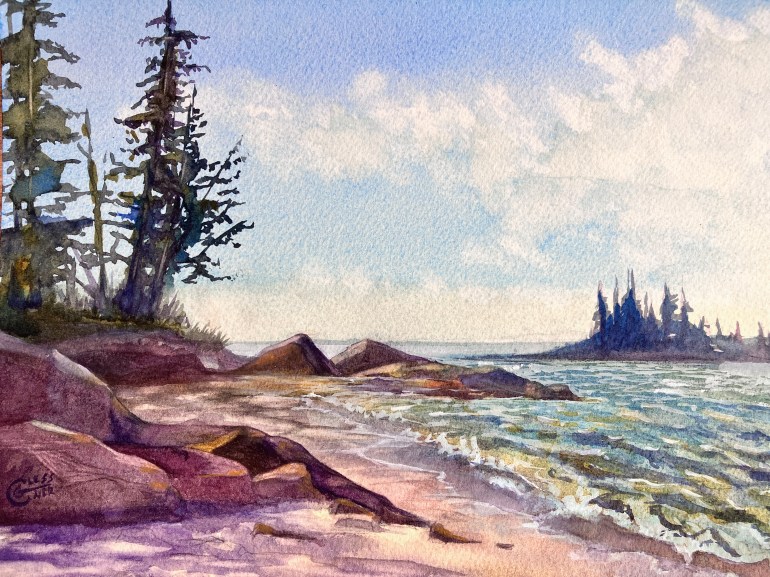
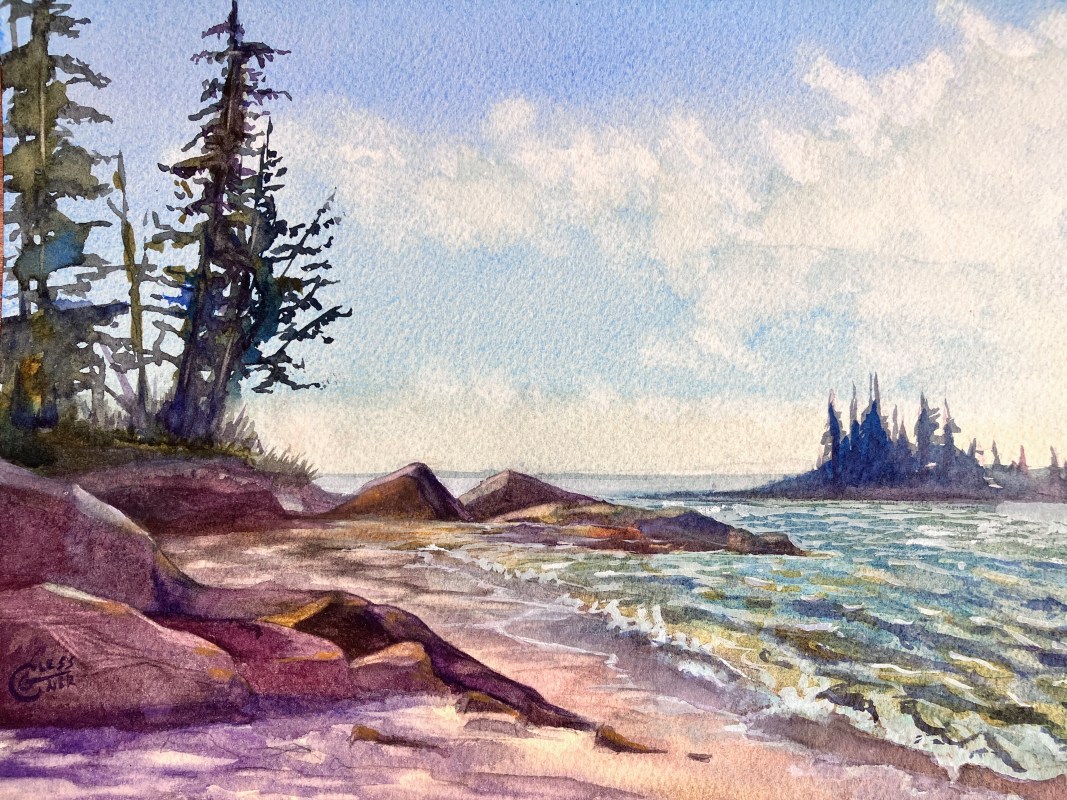
On the way back from the Vermont Watercolor Society annual meeting, my carpool buddy and I passed the time by discussing which pigments we’d use to paint the beautiful October fields and golden-hour sky. She mentioned her fondness for a special Daniel Smith mixture: Cascade Green. The appeal, she said, lay in the way the different pigments separated in a wash, dropping out at different times and creating a “cascade” of different hues. Anytime I hear about a fun multi-pigment paint, my first question is always “what’s in it?” so as soon as I got home I got to researching.
A quick search of the Daniel Smith site showed that Cascade Green is a mixture of the pigments PB17 (Phthalo Blue) and Pbr7 (Brown Iron Oxide). Unfortunately, the same pigment code, Pbr7, is used for Raw and Burnt Sienna, and Raw and Burnt Umber, so there’s no way to know which of those were used. I made a few tests with different amounts of Phthalo Blue, Raw Sienna, Burnt Sienna, and Raw Umber and was able to get similar results and colors with all three, though Raw Sienna gave slightly more granular (and I thought exciting) results. I think these compare favorably to the Daniel Smith version.
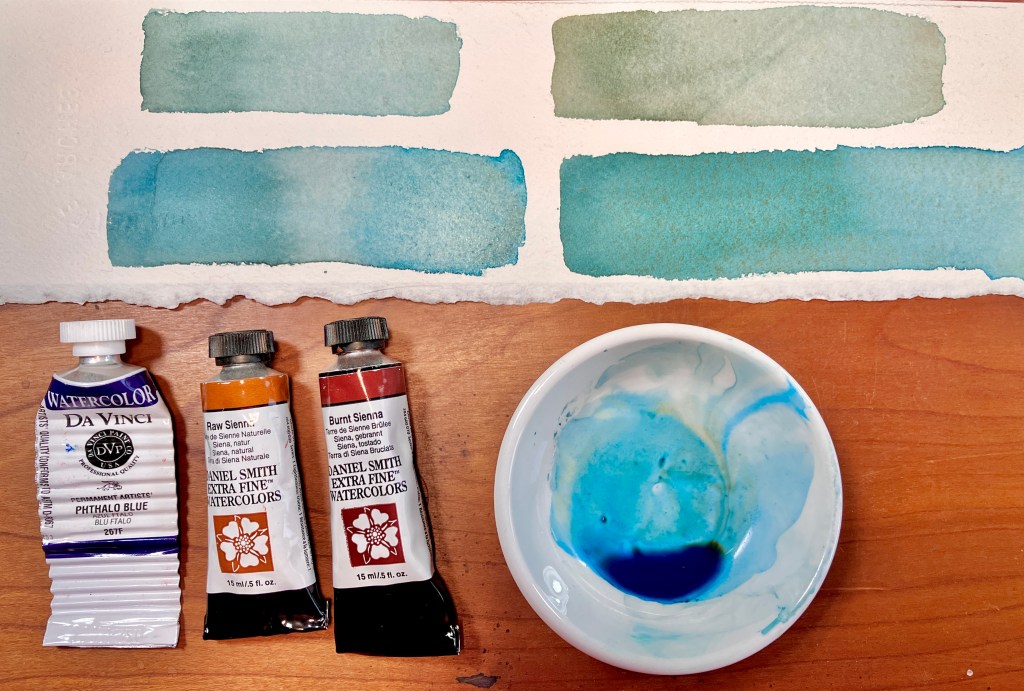
What if I wanted to make my own “cascade” mixtures with a different hue? The key here is choosing pigments with particles of different weights. Pigment particles may be heavier because they are larger, because they are made out of heavy metals or minerals, or (as is usually the case) both.
Luckily for us, Bruce MacEvoy provides the specific gravity and pigment particle size for common watercolor pigments on his eminently useful website, Handprint.
I put together this chart based on that info, with pigments that have big, heavy particles at the top; followed by pigments with medium size and weight, small size and heavy weight, and lastly pigments that are both small and light. In other words, the lower on the list, the longer it should float in a mixture.
| Pigment names | What it’s made of | Pigment size in microns | Specific Gravity | |
| Heavy | Cobalt Turquoise, Green, Violet, Cerulean Blue | Cobalt | 50µm- 10µm | 4.5 |
| Heavy | Mars Black | Iron Oxide | 10µm | 5 |
| Heavy | Cobalt Blue | Cobalt | 5µm | 4 |
| Heavy | Viridian | Chrome | 5µm | 3.5 |
| Heavy | Raw Sienna, Raw UmberYellow Ochre | Natural Iron Oxide | 5µm | 3-4 |
| Medium | Venetian Red, Indian Red, | Iron Oxide | 1µm | 5 |
| Medium | Chrome Green | Chrome | 0.5µm | 5 |
| Medium | Burnt Sienna & Burnt Umber | Iron Oxide | 1µm | 3.5 |
| Medium | Ultramarine | Kaolin Clay & Sulfur | 1µm | 2.5 |
| Light | arylidesbenzimidazolonesdioxazinesPerylenesPyrrole, Perinone | Coal Tar Derivatives | 0.5µm | 1.5 – 2 |
| Light | Prussian Blue | Iron | 0.1µm | 1.8 |
| Light | Quinacridones, Phthalos | Coal Tar Derivatives | 0.1µm | 1.5 |
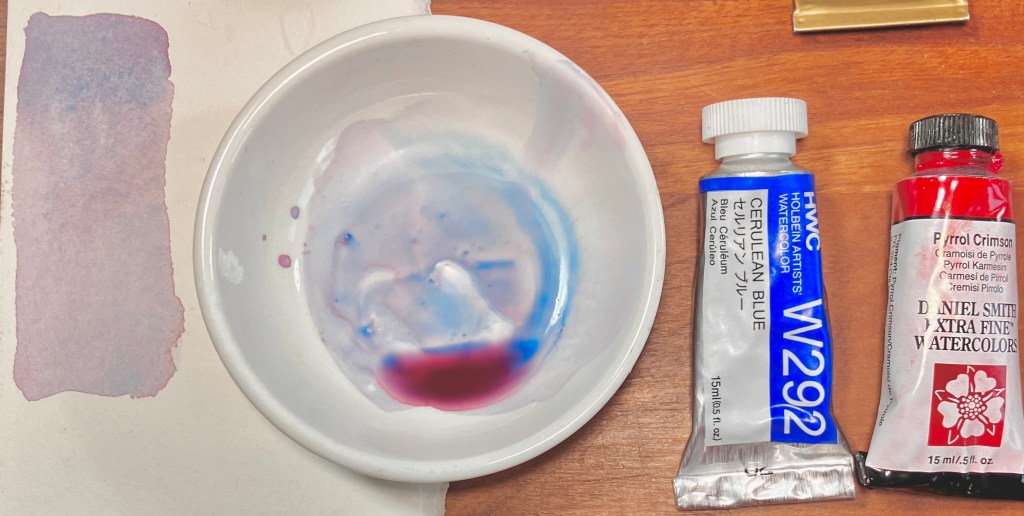
To make my own “cascade” mixture, I should be able to choose any two or three pigments of different weights and compatible hues. I decided to make a purple/blue/pink mixture to replicate the November clouds. You can check out some of my mixtures below. Results were best with mixtures that included some of the very heaviest/biggest pigments, like Cerulean Blue, Cobalt Violet, and Raw Sienna.
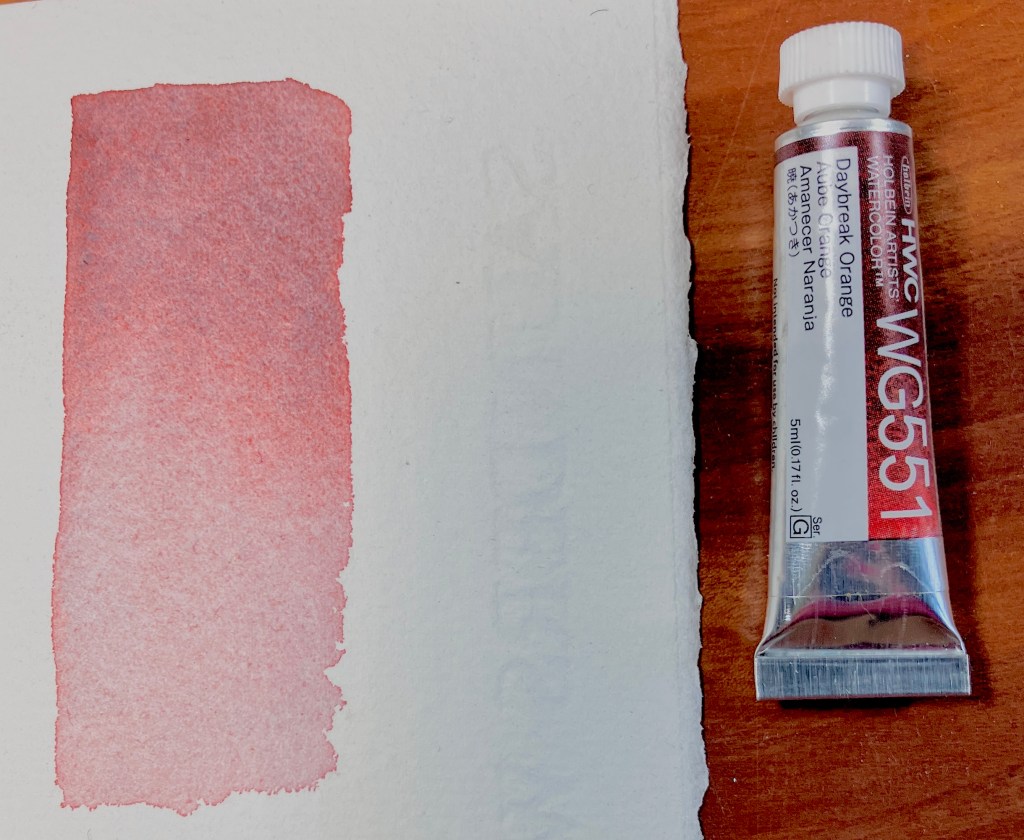
Holbein makes a line of “granulating colors” which use a mixture of heavier and lighter pigments to make cascading mixtures. Often the heavier and lighter pigments are also contrasting colors, which really plays up this effect. Below is a sample of Holbein Daybreak Orange, which is a mixture of Cobalt Green, Pyrrole Orange, and Pyrrole Red. These Holbein colors could be good inspiration for making your own mixtures, though purchased mixtures designed to separate like this may have advantages. Knowing they want to promote separation, the paint manufacturer can adjust their recipe and leave out some of the dispersant (usually oxgall) that keeps pigment particles in suspension.
Many artists have their own favorite “cascade” mixtures. For example, Ali Cavenaugh, one of my favorite portrait artists, uses a mixture of QOR Ultramarine and Phthalo Green in many of her portraits, which is now available as a convenience mixture called “Ultramarine Turquoise.”
Do you consider pigment weight when you choose paints for a project or when you assemble a new palette? Do you have your own favorite “cascade” mixture? Please share in the comments!