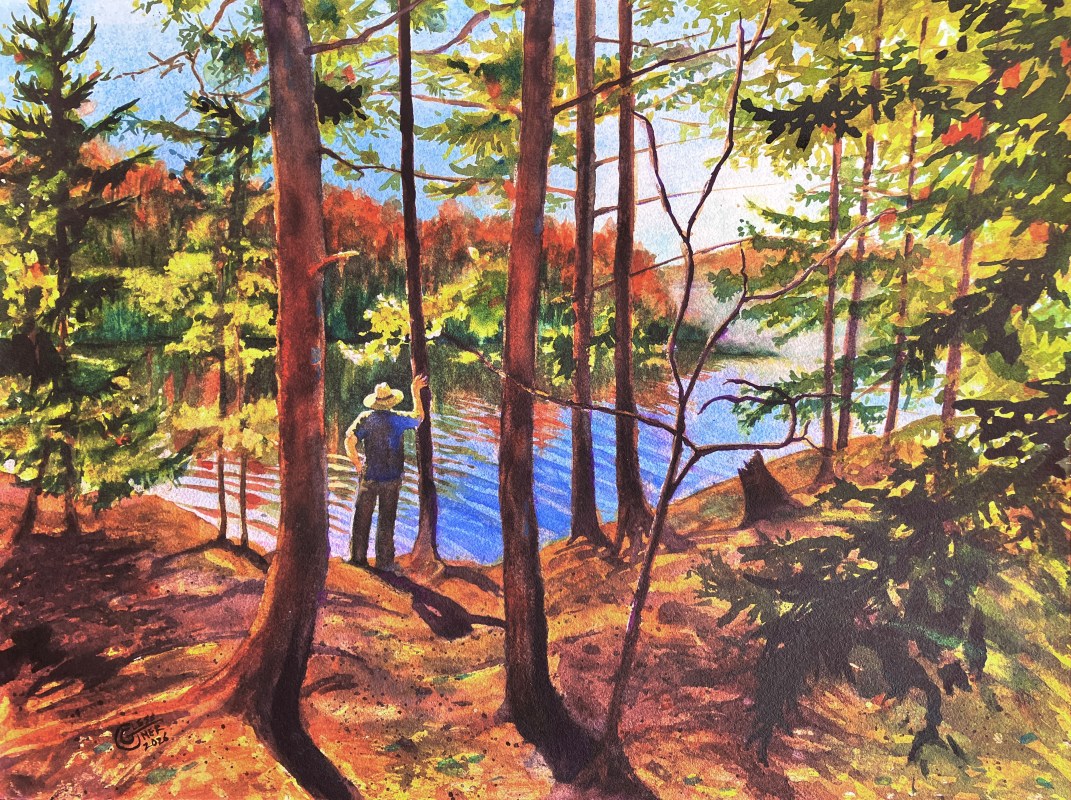
Here in Northern Vermont, spring is fleeting and summer is short. These first sunny days are treasures, not to be wasted. I want to spend them outdoors, and I want to be painting! Lucky for all of you, today is raining and 37 degrees, so I’m going to write about painting outdoors instead of actually doing it.
One of the best things about watercolor and gouache (in my opinion) are their extreme portability. Although the internet is full of complicated plein-air set-ups and pages of gear to buy, you probably don’t need any equipment you don’t have already. Gear shopping quickly becomes an excuse for not painting, so just get out there with what you’ve got! This guide should get you ready to go in an hour or less.
Why Paint Outdoors?
Knowing why you’re plein air painting may help you get off to a better start. Besides just wanting to enjoy some sunshine, there’s one big reason, in my book: you get to make all the choices.
Cameras can’t capture everything. We all know this – that’s why we travel abroad instead of just looking at photos. As I noted in “How To Take Excellent Reference Photos,” cameras (and especially phone cameras) over-darken shadows so you lose the colors found there. The camera simplifies the scene and narrows it into a frame, making choices for you about what gets left out. Cameras don’t know anything about art, so stands to reason you’ll make better artistic choices than your camera.
With the whole world in front of you, it can feel a little overwhelming to decide how to paint it – but if you dive in and start making choices to simplify what you see, you’ll start to learn what works. You’ll need to focus on big shapes, avoid fussy brushwork, and make choices quickly – all skills that will make you a better painter in and out of the studio. You won’t always make your best work outdoors, but I find that without the camera choosing for me, I make braver color choices and better compositions. It feels easier to move things around and change things up when I don’t have a 2-D representation already in front of me.
What to Pack
You can’t bring your whole studio with you, so you’ll start making choices to simplify things even before you leave the house. This will mean fewer choices to make while you’re painting – a good thing!
Paper: Work small (especially to start) so you can finish in less time. A 7×10 or 5×7 block is a good bet, or tape your paper down on all four sides to a small, sturdy board. I like my paper to be stuck down on all sides in case it gets breezy.
Paint: You probably don’t want to fuss with tubes, tiny lids, and piles of wet paint. Instead, use pans of watercolor and squeeze gouache into a box with a silicone seal like this (where it will stay moist for months). You can easily pour pans of watercolor from your existing tubes, but if you don’t have any pans now, go ahead and take your tubes outdoors. Just be careful not to lose the lids! There’s no reason to bring more than 8-10 colors with you outdoors, so cut back your palette to the colors that you’ve worked with the most so you’ll have fewer unknown variables. Just make sure you can mix a strong dark, a range of natural greens, and have some good options for sky colors. As a sample, this is what I’m using right now:
- Cerulean Blue – my favorite color for Northeastern US skies, it also makes nice, granulated grays for rocks.
- Ultramarine Blue – for mixing greens and grays
- Phthalo Green – mix with reds/pinks to get a range of evergreen shades and grey-greens for water and wet pavement
- Quinacridone Rose (PV-19) – essential for sunset and sunrise light and mixing with Phthalo Green
- A red-orange, like Pyrrol Scarlet (PR 255) or PR188 – my current favorite is DaVinci Vermilion Hue – a punchy orange that mixes with blues, greens, and purples to make a range of browns and grays
- Nickel-Azo Yellow – a primary yellow that leans towards green for nice foliage and grass colors
- Raw Sienna or Yellow Ochre – mixes with Cerulean Blue for rocks and sand, or Ultramarine for natural greens. Good for a golden glow in skies and clouds.
- A dark – I like Dioxazine Violet, which will quickly mix strong darks when paired with several of the colors on this palette. Burnt Umber or Sepia are other options for a lower-chroma palette.
- Titanium White – for watercolor, I bring this in a tube for final highlights, often mixed with yellow
Palette: Pop your pans into an inexpensive tin palette like this, and you’re good to go. For gouache, I use the same palette with the pans removed. If you don’t have a tin palette, stick your pans in an old mint tin and bring whatever you usually use as a palette.
Water and Water Jar: Bring a big waterbottle for yourself and for your wash water. A plastic container of any sort works just fine for wash water.
Rags: I prefer rags for outdoor painting as they handle more water and blow around less than paper towels – but paper towels work as well.
Spray Bottle: A spray mister is essential outdoors as your paints will dry out much quicker and you’ll need to keep misting them to keep them moist.
Brush: Keep it simple and just bring one or two brushes. I like a no. 8 or 10 round for watercolors or a 1/2″ flat for gouache. I wrote about sizing your brush to your paper here. I usually don’t bring my expensive sables outdoors, as I have a tendency to drop brushes in the dirt. A travel brush is a great way to avoid smushing your brush in transit – I like this inexpensive brush set, or the ones from Rosemary and Co. If you don’t have a travel brush, take the plastic sleeve a brush comes in and slice it vertically with a pair of scissors so you can open it up. Now you can slide it over a brush from the handle end so the bristles are protected without getting bent backwards. You might want to tape it in place so it doesn’t slide off in your bag. A small piece of cardstock can be used the same way.
Small sketchbook, mechanical pencil, and eraser
A camera or phone
Whatever you need to stay healthy and happy – bug spray, sunscreen, snacks, etc.
A small backpack or tote bag to carry everything
If you don’t mind sitting on the ground (or the hood of your car, or a park bench) and working with your paper in your lap and your palette in your hand, then that’s all you need! I usually bring my trusty Crazy Creek camping chair to make sitting on the ground more comfortable. If sitting on the ground isn’t possible for you, a collapsible camping chair with an attached cup holder for your wash water and an armrest where you can attach your paint box works great.
Easels
If you’d rather stand, you’ll need an easel. Easel shopping is an internet rabbit-hole, so if you don’t have an easel, you might want to just go outside now and easel shop on a rainy day. There are many choices out there. Us watercolor and gouache painters can use the simplest, lightest, and cheapest options without issue. The two characteristics you want to look for are:
- Can hold your work surface level or at the angle you prefer to work at. Some easels for oil and acrylic painters only hold canvasses vertically.
- Adjusts with locking cams – you don’t want to be fiddling around with wing-nuts in the woods
This is the easel I’m using currently, which I got on sale for $50 and I’m happy with – but there are other options out there. Look for a video of someone setting up and taking down the easel you’re considering so you can see if it’s fast and simple to use and adjust. There seem to be a lot of wooden easels out there that are beautiful, but heavy and impractical to take anywhere. Although they’re cute, you don’t need an easel with compartments for storing things, which just adds bulk and weight, and you don’t need a special box to hold wet paintings (those are for oil painters). If you have a camera tripod already, you can adapt it for painting by gluing or screwing a camera mount to a piece of hardboard where you can attach your paper – this is a popular option used by many professionals. Buying a used easel is also a great idea, especially if you can see it in-person to make sure nothing’s broken. Facebook Marketplace and Ebay are good places to find them.
If you’re using an easel, you also need to be able to attach your water jar, rag, and paint box to your easel. There are lots of ways to do this. Spring clamps work well to clip things in place, or you may be able to hang things from the easel with string or carabiners. A collapsible water bucket with a handle helps with this. If you have a metal easel, you can glue strong magnets to your tools and stick them in place. Some easels have detachable table “add ons.” Don’t rely on balancing things on a rail or rack – they’re likely to get blown or bumped off. Set everything up inside before you go out to make sure your set-up works.
Painting in All Weather
You should always paint in the shade. Painting in the sun can lead you to make your colors too dark, and your paint will dry very quickly and maybe unevenly and unpredictably. Your pans of paint will dry out with annoying rapidity, and you’ll get sunburned. The easy solution is to position yourself in the shade (keeping in mind that the shade will move with the sun). If staying in the shade seems like it’s holding you back from painting what you want, consider bringing an umbrella. A clip-on version can attach to an easel or the back of a camp chair. If it’s windy and you’re painting with an easel, a stone bag (buy one or make your own) attaches to your easel to weigh it down. My solution? Work smaller and don’t paint on an easel on windy days.
Outdoor Painting, Step-by-step
You’re geared up and outside – now what? Breaking down the vast expanse of nature into a bite-sized painting is a challenge, so it might be hard to know where to start. Here’s what I do, step-by-step.
- Choose a small portion of the landscape to paint. Use your thumbs and forefingers to make a frame, hold out your arms, and frame various parts of the landscape to find a composition you like. Squint your eyes (or take off your glasses) to blur details and flatten your depth perception. What do I mean by details? I’m talking about distant buildings, blades of grass, individual leaves and flowers, windows on a house, textures and trims.
- Take a photo of the area you’re painting. This can help you check the composition, and will give you a reference in case the weather changes or you need to finish the painting indoors.
- Make a “thumbnail” value study in your sketch book. This could be only a few inches in size. Define the big shapes in your composition and assign them each a value. If you’re painting with gouache, you can paint the value study right on your canvas using one diluted color (Raw Sienna or Yellow Ochre is a popular choice) although you may still prefer to make a sketch in a notebook first. Think about what main color you’ll use for each shape, and test them on your paper if needed. Making choices about how to simplify your scene now will help you paint it quickly, before the light changes. If this kind of simplification is unfamiliar to you, or something you have trouble with, I strongly recommend reading The Landscape Painter’s Workbook by Mitchell Albala, which will get you headed in the right direction.
- Make any guidelines you need on your paper. If you normally make a very detailed drawing, consider just doing a few lines to define the big shapes from your sketch, so you can get painting faster. You can always add details later on, indoors, using the photo you took as a guide.
- Start painting! Start with the sky – it’s usually the lightest thing in the painting, and you’ll be able to paint other things over it. This lets you capture cloud formations before they move.
- Next paint a first layer over the ground, and add in any shadows right away before they change. You can always darken them later, as long as the location is captured.
- Paint the rest of the big shapes, but don’t paint any details.
- Step back from your painting and evaluate the composition, comparing it to your value study. Make any adjustments.
- NOW you can add details. Or take your painting home and add the details later. Your big shapes should capture the light and shadows and everything your really need to know about the scene to make your painting hang together – and adding more details won’t fix it if it’s not working. In fact, you may decide to stop without adding any details at all!
Hopefully, this quick guide has you ready to go out and paint! My computer says it will take 12 minutes to read this, which gives you another 45 to pack up your gear, make a peanut butter sandwich, and get outside!
 Carrie Glessner